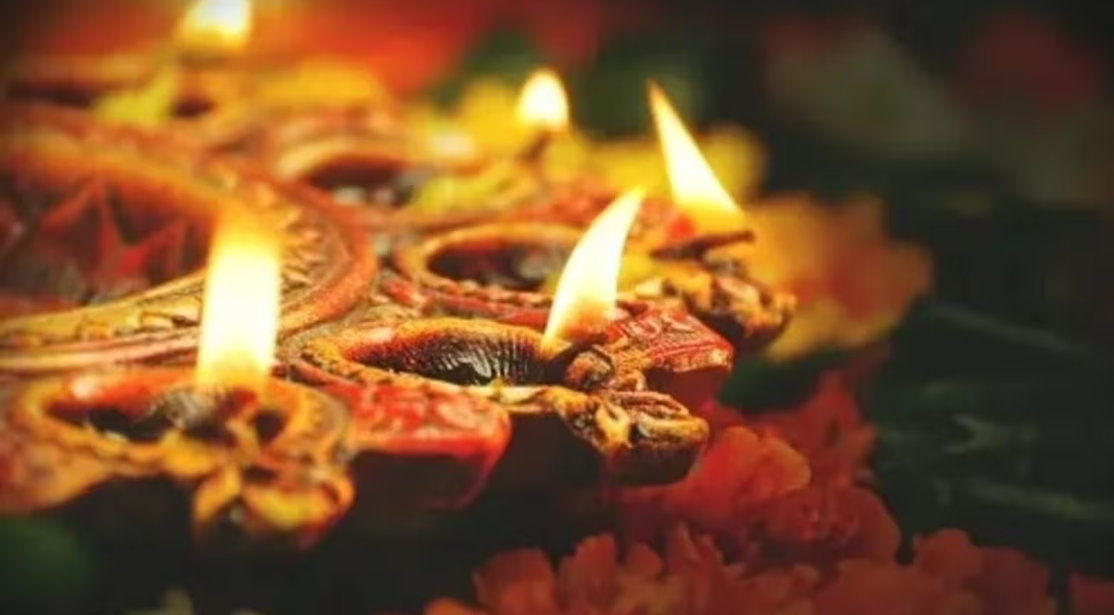

Bhagavan Nityananda and Diwali celebration

Bhagavan Nityananda—The Embodiment of Simplicity and Renunciation
Bhagavan Nityananda, whom we lovingly called Swami or Baba, was the living essence of purna vairagya—total renunciation. His simplicity was not cultivated; it was innate, natural, and unshakable. Clothed in nothing more than a simple langoti, he bore no outward signs of spiritual attainment—no Rudraksha or Tulsi malas, no sandalwood or vermilion marks. He adorned nothing, yet radiated everything. His very being was attuned to the rhythm of nature—silent, seamless, and ceaseless.
On rare occasions, Baba accepted a sweater or a kafni offered by devotees out of deep affection. But he would wear them only briefly—just long enough for the devotees to see their offering accepted—then quietly remove them as soon as they left, whether it was the chill of winter or the swelter of summer. In his early days, he sometimes draped a blanket over his shoulder while walking through the village. But as his presence began to draw increasing numbers of devotees, these walks became less frequent—his freedom absorbed by the love of the many who came to seek his grace.
He preferred not to be garlanded. Devotees would usually lay their offerings silently at his feet. Only a few were permitted, with his blessing, to perform Padya Pooja—a tender ritual washing of his feet with water, milk, and coconut water, followed by the gentle application of sandalwood oil and a humble offering of Bel and Tulsi leaves. On rare occasions, such as during Diwali, he allowed a Tulsi garland to be placed around his neck. I remember how my mother would lovingly craft light garlands by spinning threads from longcloth, decorating them with roses and delicate velvet flowers. Baba looked radiant with these simple offerings draped around his shoulders, though he never allowed a tikka to be applied to his forehead.
Diwali was a special time. We offered him traditional Konkani delights—set dosa, panpola, and sevai served with sweet coconut milk. Baba would taste just a little, and then hand the plate to my father, who received the prasād with reverence, knowing its sacredness lay not just in the food, but in the love with which it had been accepted.
Baba never wore a cap or turban. In his youth, during his time in Mangalore, he was occasionally seen in a plain half-sleeve bush shirt, seated on a bench, welcoming all who came, speaking little, answering questions with few words, but with a gaze that pierced illusion. Now and then, he would wear a kafni for a few hours. Once, before India’s independence, while in Bombay, he surprised everyone by asking my father for a three-piece suit. A tailor came, took his measurements, and soon Baba was walking the streets of Bombay in full Western attire—with my father by his side. But as suddenly as he had taken to it, he discarded the suit, returning to his seamless simplicity. These gestures were beyond comprehension, yet profoundly meaningful—perhaps to show that even the trappings of the world could not bind him.
Each Diwali, we brought our business ledgers to Ganeshpuri for Chopdi Pooja—the ceremonial blessing of the account books at the start of the new financial year. We would place them before Baba, and on the first page of each book, draw a red swastika and inscribe “Shubh Labh” (auspicious profit) with a wooden pen dipped in vermilion paste. Baba’s blessings were our only security, our greatest wealth.
My father would also carry a large wooden crate filled with fireworks, which we distributed among the village children. Their laughter and joy echoed through the night, lighting up the atmosphere as much as the lamps we placed around Kailash Bhavan and Vikunth Ashram, now the Samadhi Mandir.
Much has changed. Today, Chopdi Pooja has faded, replaced by accounting software like Tally. But Diwali in Ganeshpuri still glows. Lamps illuminate every corner of Kailash and the Mandir. Sweets are shared. The air is fragrant with memory.
And as I stand in the glow of the countless diyas, I remember Him, seated on the stone slab, silent as ever, while we washed his feet. His eyes glowed not just with light, but with Shakti—with boundless love, care, and benevolence. It is this light that still burns within me, quietly guiding me, especially in moments when all else fades.


There are 2 comments on this post
"Baba adorned nothing, yet radiated everything". Such powerfully potent words. May the Shakti of Baba shine forth through your words. This Shakti of Baba transports us into the times all lived with Baba and infuses us with His love, guidance, care and protection. Om Namah Bhagawate Nityanandaya 🙏
He was He, quite Unique, Roshniji! Hewas like Ocean, all encompassing, yet stnadalone! Strong, but compassionate! Infinite, yet mine!