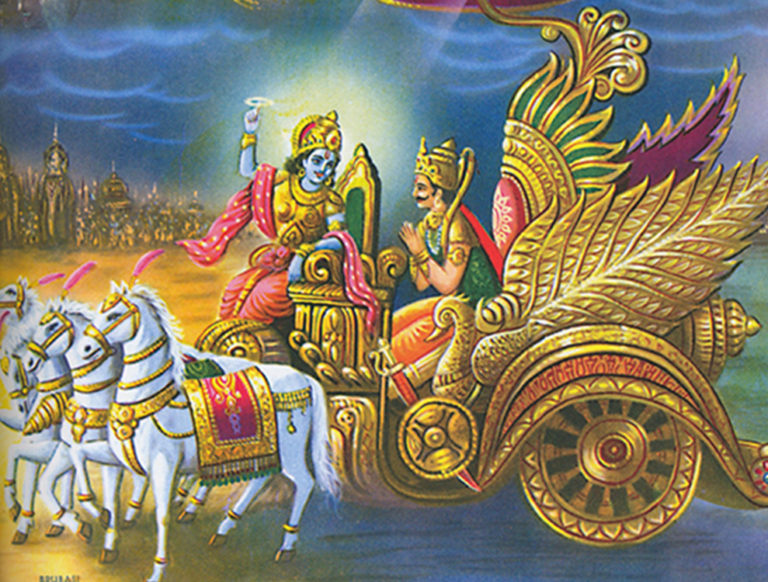

Why Daily Practice (Abhyas)?

Why Do We Read the Gita, Even If We Don’t Understand It?
Someone shared a beautiful story with me today. I feel compelled to pass it on.
An old farmer lived in a quiet village nestled in the mountains. Every morning, he would rise early, sit by the kitchen window, and read from his cherished copy of the Bhagavad Gita. Watching him closely was his young grandson, who admired his grandfather deeply and tried to imitate him in every way.
One day, the boy finally asked,
“Grandpa, I try to read the Gita just like you… But I don’t understand it. And even what I do understand, I forget as soon as I close the book. What’s the point of reading something I can’t remember?”
The grandfather paused. Then, without answering, he turned from the stove where he was putting coal and handed the boy a coal basket, blackened and worn.
 He said,
“Take this basket down to the river and bring me back a basket of water.”
Though puzzled, the boy obeyed. He filled the basket in the river, but by the time he ran back home, all the water had leaked out. The grandfather chuckled and said,
“You’ll have to move faster next time.”
So the boy tried again — and again. Each time he returned with an empty basket. After several tries, exhausted and frustrated, he cried,
“Grandpa, it’s useless! This basket can’t hold water. Let me get a bucket instead.”
But the old man gently replied,
“I didn’t ask for a bucket of water — I asked for a basket of water. Try once more, just one last time.”
Wanting to prove his point, the boy made one final attempt, running faster than ever. Still, the basket was empty when he returned.
“See? It’s hopeless!” he exclaimed.
The grandfather smiled, took the basket from the boy’s hands, and said,
“Look closely.”
The boy looked down and gasped.
The basket, once stained with coal and soot, was now clean — inside and out.
The grandfather placed a gentle hand on his shoulder and said,
“Son, that’s what happens when you read the Bhagavad Gita. You may not understand or remember much. But just like the river water cleanses the basket, the words of the Gita slowly cleanse the heart. With each reading, something inside you is quietly transformed — even if you don’t notice it at first. That’s the silent work of Krishna in our lives.”
This is indeed a beautiful and profound story — a parable of persistence, transformation, and grace. It subtly reveals the essence of Abhyās Yoga, as taught by Lord Krishna in the Bhagavad Gita, and echoed through the silence and presence of Bhagavan Nityananda. Let’s now elaborate on Abhyās Yog (Yoga of Practice) and how this story captures its spirit.
What is Abhyās Yog?
“Abhyāsa” means sustained, repeated practice with sincerity and devotion over time. “Yoga” is union — the merging of the limited self with the Supreme. So, Abhyās Yog is the discipline of consistent spiritual practice aimed at uniting with the Divine.
In Bhagavad Gita, Chapter 12 (Bhakti Yoga), Verse 9, Krishna says:
“Athachittam samādhātum na shaknosi mayi sthiram,
Abhyāsa-yogena tato mām ichchhāptum dhanañjaya.”“If you are unable to fix your mind steadily on Me, then by the practice of Abhyās Yoga, try to reach Me, O Arjuna.”
This verse comes after Krishna extols the highest path: surrendering one’s whole being in love to God. But understanding our human limitations, Krishna compassionately offers a step-by-step approach. If spontaneous devotion is not possible, practice it steadily. That is Abhyās Yog.

The Story Reflects Abhyās Yog
The grandson reading the Gita mirrors the life of a seeker who practices, sometimes without immediate understanding or results. His struggles, doubts, and frustrations are real. But the story’s brilliance lies in the coal basket metaphor:
-
The basket could not hold the water, yet it became clean.
-
Similarly, the Gita may not seem to “stick” in the mind, but its vibrations, its Shakti, purify the being.
-
Transformation happens subtly, not necessarily at the level of intellect or memory, but deep within the heart and subconscious.
This purification — the chitta-shuddhi — is the primary fruit of Abhyās Yog. One becomes fit for Grace, just as the basket becomes ready to carry clean water.
Bhagavan Nityananda and Abhyās Yog
Though Bhagavan Nityananda rarely gave discourses, his very presence radiated the fruits of Abhyās — stillness, selflessness, and the power of pure awareness. He once said:
“The mind that goes outward is the cause of bondage; the mind that turns inward is the cause of liberation.”
This turning inward, again and again, despite distraction, despite fatigue, despite doubt, is Abhyās Yog. Bhagavan’s life shows us that:
-
One does not have to “understand” spiritually in the worldly sense.
-
One must simply continue with Shraddha (faith) and Saburi (patience).
-
The Guru’s presence itself transforms the heart, like the water cleaning the basket.
The Secret Power of Abhyās Yog
-
It builds inner receptivity – Just as the basket became clean, Abhyās makes us capable of receiving higher truths.
-
It bypasses the ego – It teaches humility: “I may not understand now, but I trust and persevere.”
-
It draws Divine Grace – As Krishna says, even a little effort on this path is never wasted (Gita 2.40).
-
It deepens Bhakti – Repetition naturally tunes the mind to the object of devotion, nurturing love and surrender.
Thus
-
Abhyās Yog is not about brilliance; it is about steadfastness.
-
The Bhagavad Gita, like the river, cleanses even when its depth is not grasped.
-
Just as the basket changed from the inside, the seeker, too, is gradually transformed by divine practice.
-
Bhagavan Nityananda and Lord Krishna both show us — it is not about “getting” something, but becoming something.


There are 5 comments on this post
Amazing metaphor
Thank you Seshappa for visiting us and giving your feedback. We look forward to your regula visits and blessings.
In His Prem,
At His Lotus Feet,
I remain
Gopalkrishna
Wonderful Dr Gopala Krishna Shenoy . AMA devotee of Nityananda through his disciple Sri Sadhashiva Yogi of Hampi in Karnataka
Thank you so much Seshappa. Please share pictures of Shree Sadhashiva Yogi and his Ashram of Hampi.
In His Prem,
I remain
Gopalkrishna
Gopalkrishna Shenoy Maam💗💗🙏