
The Auspicious Moment of 10:43 am
A Living Portal to Bhagavan’s Eternal Presence

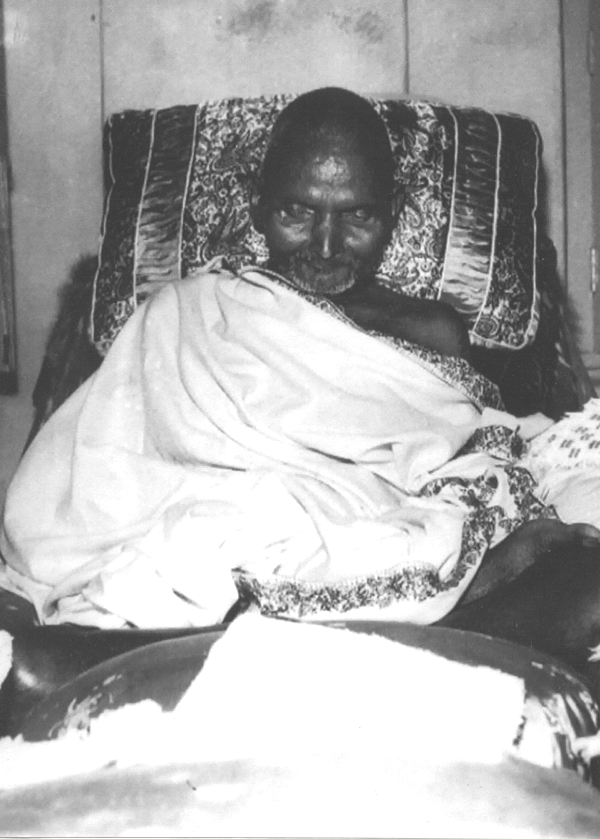

Bhagavan Nityananda shed His mortal frame on 8th August 1961, at precisely 10:43 am—a moment that holds a quiet yet profound significance. When the digits of this time are summed (1+0+4+3), they total to 8, echoing the date itself (8/8/1961 → 8). In the subtle language of mysticism, numbers often carry symbolic resonance, and the number 8—suggestive of infinity, balance, and the unending cycle—seems uniquely aligned with Bhagavan, who lived established in the Infinite, beyond all dualities.

Thus, 10:43 am is not merely a point in time; it is a living doorway, a Punyagadhi—a sacred juncture through which a devotee can inwardly connect with Bhagavan’s eternal presence.
This understanding was deeply affirmed by Gopal Anna, one of Bhagavan’s lifelong sevaks. With great conviction, he once shared:
“This is the moment when Bhagavan assumed His Nijaswaroopa—His true, formless essence. If a devotee wishes to connect with Him, call out to Him at exactly 10:43 am. At that moment, He is most accessible, ever ready to respond to a sincere call.”
Such words were not mere instruction—they were lived truth, born of direct experience.
A Living Tradition of Remembrance
To honour this sacred moment, devotees continue to perform Arti at exactly 10:43 am at the Bangalorewalla Building in Mumbai—the very place where Bhagavan entered Mahasamadhi.
This daily Arti is not just a ritualistic observance. It is a reaffirmation that:
- Bhagavan’s presence has not receded
- His grace continues to flow
- His accessibility remains unchanged
Time, here, becomes a bridge between the seen and the unseen.
Extending the Sacred Rhythm
Inspired by this living tradition, I was inwardly moved to initiate an Arti at 3:05 pm at the Kanhangad Ashram—the moment when Shree Swami Janananda, the beloved disciple of Bhagavan, attained Mahasamadhi on 27th December 1982.
Though this practice is not widely followed, for me it remains a deeply sacred hour—a silent invitation to turn inward, to remember, and to rest at the feet of the Sadguru.
Such moments are not bound by external recognition; their sanctity lies in inner connection.
A Mystical Confluence at 10:43 am
A particularly profound experience unfolded on 14th September 2022, during my visit to Narsoba Wadi—a sacred kshetra associated with Narasimha Saraswati, revered as an incarnation of Dattatreya.
On that day, the Dakshin Dwar (Southern Door) opened, and the waters of the Krishna River rose in a divine play, flowing forward to touch the Nirgun Paduka—the formless symbol of the Guru’s presence.
At that exact moment—10:43 am—I was blessed with the Darshan of these sacred Padukas.
Time stood still.
It was as if the river herself had become a living conduit—carrying the grace of the Sadguru, uniting the seeker with the Source.
In that ineffable moment, I experienced Bhagavan Nityananda as none other than Narasimha Saraswati—revealing the indivisible oneness of the Guru Tattva across names, forms, and traditions.
The Eternal Presence
This was not merely symbolic—it was experiential.
It was a direct glimpse into the truth that:
- The Guru is not confined to form
- The Guru does not belong to time
- The Guru is a living principle—ever-present, ever-accessible
The waters of the Krishna seemed to carry the Lotus Feet of the Sadguru to me.
What unfolded in that moment was beyond words—a silent assurance, a deep inner knowing.
A Moment That Lives On
Bhagavan Nityananda is not a memory of the past.
He is Nitya—ever-present.
And for those who turn to Him with sincerity, even today, that sacred moment of 10:43 am becomes:
- A time of inward turning
- A point of connection
- A doorway to grace
Not because of the clock—but because of the bhāva it invokes.
A Gentle Invitation

For a devotee, it is not necessary to seek extraordinary experiences.
It is enough to pause, remember, and call upon Him with sincerity.
Perhaps, at 10:43 am, one may simply close the eyes…
turn within…
and offer oneself.
For in that stillness, one may discover—
He was never away.


There are 13 comments on this post
Thx for beautiful connection with Nityananda
Thank you for visiting our site and leaving your kind response
Beautiful..
Thank you for sharing these rare miracles happening in your life while Bhagwan Nityananda lovingly watches over our lives and lives amongst us. We are blessed to have Bhagwan Nityananda in our life through our parents who met Him 🙏🙏🙏
Thank you Roshniji for visiting the site and leaving your feedback and sharing your connection with Bhagavan Nityananda. They inspire and motivate to share His grace.
Thanking you,
In His Prem,
At His Lotus Feet,
I remain
Gopalkrishna
I'm truly fortunate 😊
I'm also born on 8th August when Bhagwan Nityananda took mahasamaadhi
Thank you for sharing the blessings 😊🙏🏻
Jay Shree Nityananda 🪷
Jai Nityananda
धन्यवाद आपल्या मुळे माहिती मिळत आहे
Thank you so much for visiting the site. Your feedback is indeed a blessing.
Thank you for sharing the moment and letting us know about the auspiciousness of 10:43 am. (You write that you visited Narsobawadi in 1922, but that sounds a little strange. When was your visit?)
There is an error. It was 2022. Extremely sorry for this. My problem is I write in whatever little time I get. There ois so much to share and time is running out. This sense of urgency, some concerns on forgetting many details, etc do trouble me. Many times I do not get time to revisit/edit/correct. Presently I am more concerned on sharing for posterity so that whatever I got from elder devotees who were His direct devotees with future generations of devotees.
My apologies and many thanks for drawing my attention.
In His Prem,
Gopalkrishna
Belleza pura ♥️🙏
Jai Nityananda