
Offerings to Bhagavan Nityananda: The Essence Beyond Form
What flowers, what fragrance, what prasād should be offered to Bhagavan Nityananda?
In the traditional path of devotion, different deities and saints are associated with specific offerings. For example:
- For Lord Dattatreya, flowers such as jasmine, parijat, and chaffa are considered auspicious. Fragrances like henna are offered, along with dhoop, and preparations such as kesar goda bhaat (saffron-infused rice) are made as prasād.

For Swami Samarth, devotees often offer henna fragrance, besan laddoos, and flowers like chaffa or son champa (Michelia champaca). Tulsi leaves and bel leaves are also offered. It is also known that He partook of a hookah, which devotees would offer with reverence.


Bhagavan’s Unique Way
Bhagavan Nityananda did not prescribe or encourage any specific form of offering.
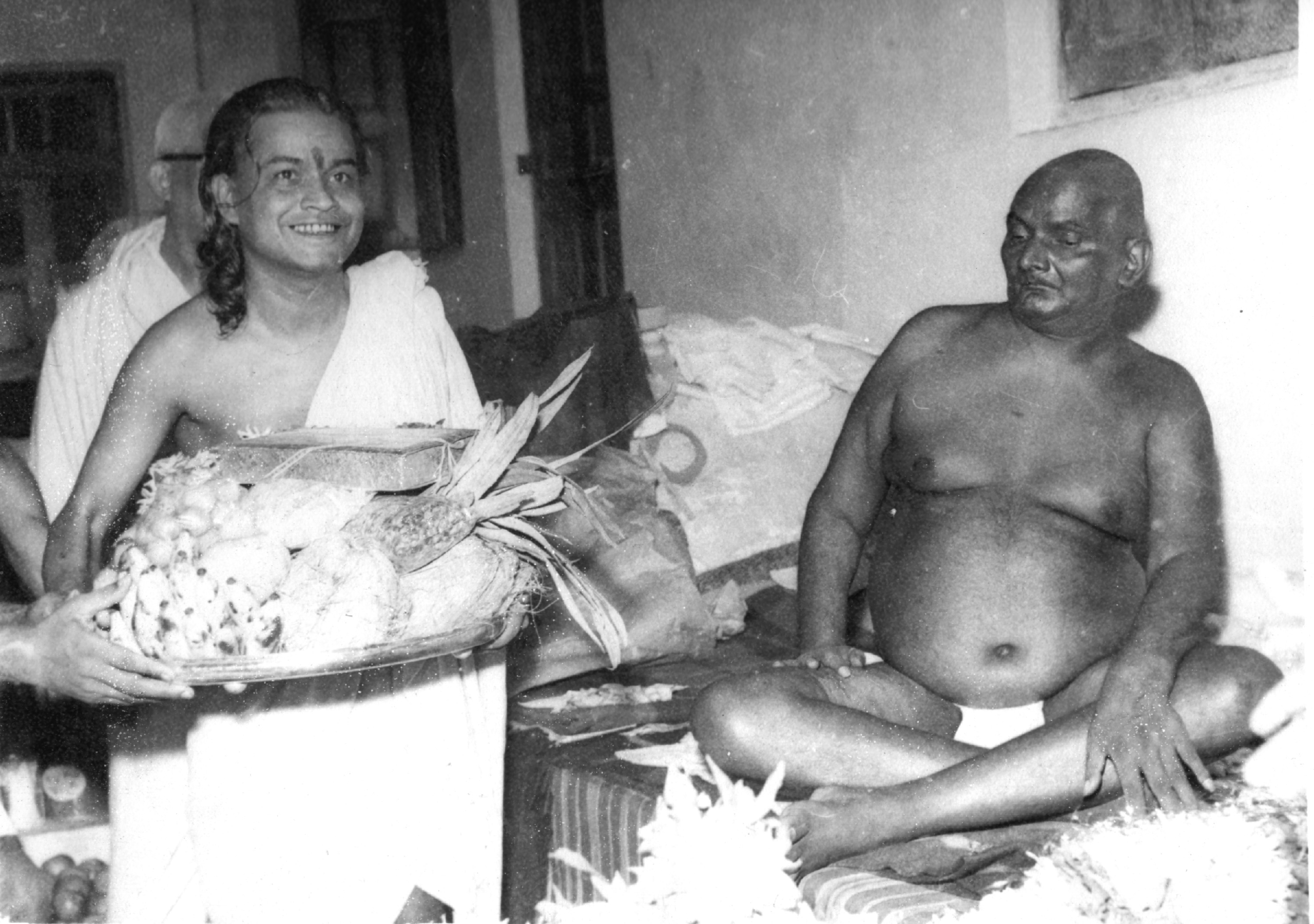
He did not allow anyone to garland Him. Nor did He generally partake of food offerings brought by visiting devotees. Instead, whatever was offered would often be distributed to all—especially to children—reflecting His natural compassion and detachment.
At times, devotees would prepare a thick garland made of fresh Tulsi leaves, carefully handcrafted with devotion. Very rarely, Bhagavan would allow such a garland to be placed around His neck, and even then, only for a few moments. More often, it was placed at His Lotus Feet.
Food Offerings: Simplicity and Sharing
Bhagavan’s approach to food was simple and inclusive.
He was known to appreciate suji sheera for distribution, especially because it could be easily distributed among village children. In earlier days, beaten rice with jaggery was also prepared and shared.
His own food was simple:
- Rice and sambar
- Vegetables seasoned with mustard seeds and curry leaves
- Pickles and papad
Devotees from Maharashtra and the Konkan would bring their traditional preparations, which He would accept in small quantities.
Uniquely and symbolically, He would often mix all the food items together—sweet, spicy, sour—into one, and partake of it as Krishna Kaala, signifying an equal acceptance of all experiences.
At times, He would have simple kanji (rice gruel) with mango pickle, or lemon mixed with salt, ginger, and green chillies.
Fragrance and Personal Seva
Among fragrances, sandalwood oil was offered with great devotion.
In those days, pure sandalwood oil was available. My father would procure it from a devotee at Masjid Bunder*. It was stored in a long aluminium bottle with a soft cork. He would carry it with him, and whenever the opportunity arose, he would take a little oil in his palm and gently apply it to Bhagavan’s Feet, massaging them with reverence.


The room would soon be filled with the soothing and divine aroma of sandalwood.
Duty First- Kandlurkar Narshimha Prabhu
The Inner Signhttps:
Tulsi leaves, especially with Manjari, symbolise pure and selfless love.
Thus, offerings such as:
- Tulsi leaves with Manjari
- Simple food like rice and sambar
- Sandalwood oil
were made—not because they were prescribed, but because they arose from devotion.
In truth, Bhagavan had no preference.
He accepted everything—or nothing—with the same equanimity.
The Essence of Offering
Bhagavan Nityananda did not seek offerings—He transformed the very idea of offering.
What mattered was not:
- The type of flower
- The fragrance
- The food
But the bhāva—the inner feeling.
Anything offered with love was accepted.
Anything offered without it held no meaning.
In His presence, offering was not an external act—it was an inner surrender.


